Growers' Pride: Tilia mongolica 'Buda'
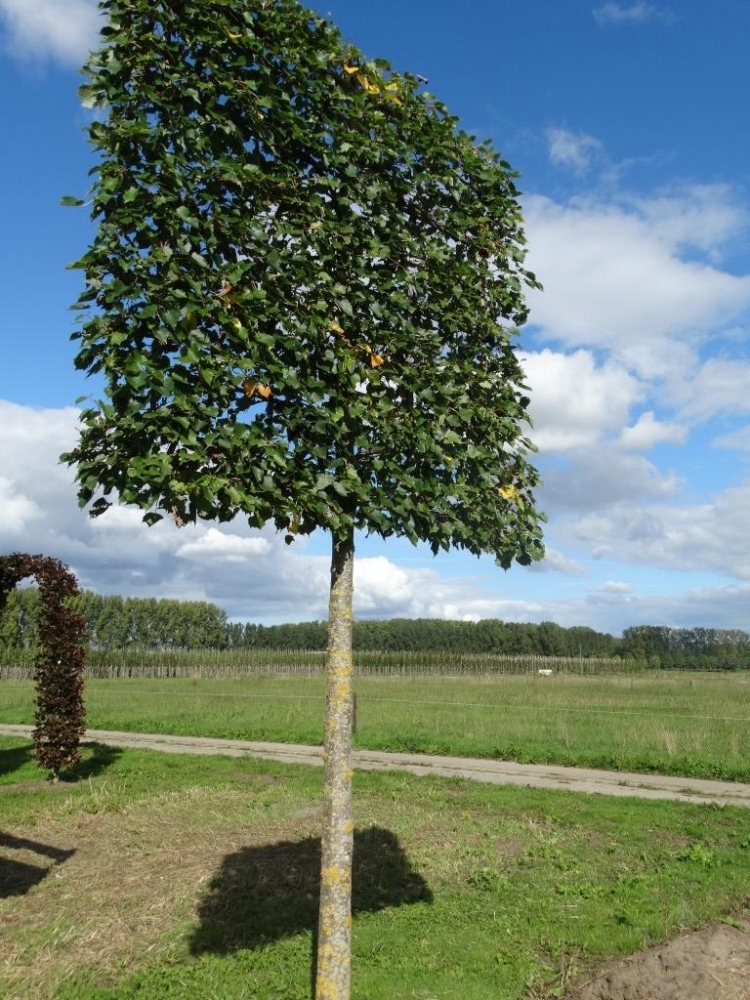
Anyone who associates lime trees primarily with large trees and wide crowns should take a closer look at Tilia mongolica ‘Buda’. This selection of the Mongolian lime remains relatively compact, eventually reaching around 8 to 12 metres, and has a distinctive appearance thanks to its foliage and crown shape.
That individual character makes ‘Buda’ an interesting tree for Vormboomkwekerij Ruud van den Berk in Sint-Oedenrode. The nursery specialises in trained trees and multi-stem trees and includes Tilia mongolica ‘Buda’ in its assortment. It works well as a specimen tree, while its regular crown structure also makes it attractive wherever a clearly defined tree shape is required.
The foliage makes the difference
Seen up close, it is immediately apparent that this is not an ordinary lime. The leaves are relatively small, glossy dark green and heart-shaped to triangular. Particularly striking is the serrated leaf margin. In this respect, ‘Buda’ differs from the species Tilia mongolica, whose leaves are generally more distinctly lobed.
Its growth habit adds to its elegant character. ‘Buda’ develops a broad, ovoid and fairly dense crown. The tips of the branches and twigs hang slightly downwards, giving the tree a softer and more graceful appearance without compromising its regular shape.
There is a second ornamental feature in autumn, when the dark green foliage turns yellow, keeping the tree visually prominent towards the end of the growing season.
Medium-sized and widely applicable
With a mature height of approximately 8 to 12 metres and a crown width of around 7 to 10 metres, ‘Buda’ is a medium-sized tree. This makes it an interesting choice for locations where a mature tree is required but where a very large lime would eventually demand too much space.
The tree performs on a range of soil types, tolerates dry soil and has good wind resistance. It can also cope with semi-paved situations. These characteristics make it suitable for a variety of applications, from private gardens and landscape projects to avenues and wider streets.
Cream-coloured flowers appear in June and July. In addition to its foliage, crown shape and autumn colour, the tree therefore offers floral value and provides a food source for bees as well as supporting butterflies.
Selected in Budapest
‘Buda’ was selected by the University of Budapest in Hungary and was already in cultivation before 2010. The selection combines the distinctive character of the Mongolian lime with a regular, dense crown and a size that remains manageable in many landscape situations.
That combination is what gives Tilia mongolica ‘Buda’ its place within the broad range of lime trees. It is not the largest or the most exuberantly flowering lime, but a tree in which several qualities come together: distinctive foliage, elegant growth, strong yellow autumn colour and a mature size suitable for many locations.
Growers’ Pride: Tilia mongolica ‘Buda’ from Vormboomkwekerij Ruud van den Berk – a compact, characterful lime tree whose distinctive foliage and elegant crown give it a place of its own in the assortment.