- HOME >
- NEWS >
- Cultivation 28-05-2026
‘Young plants need to become predictable’
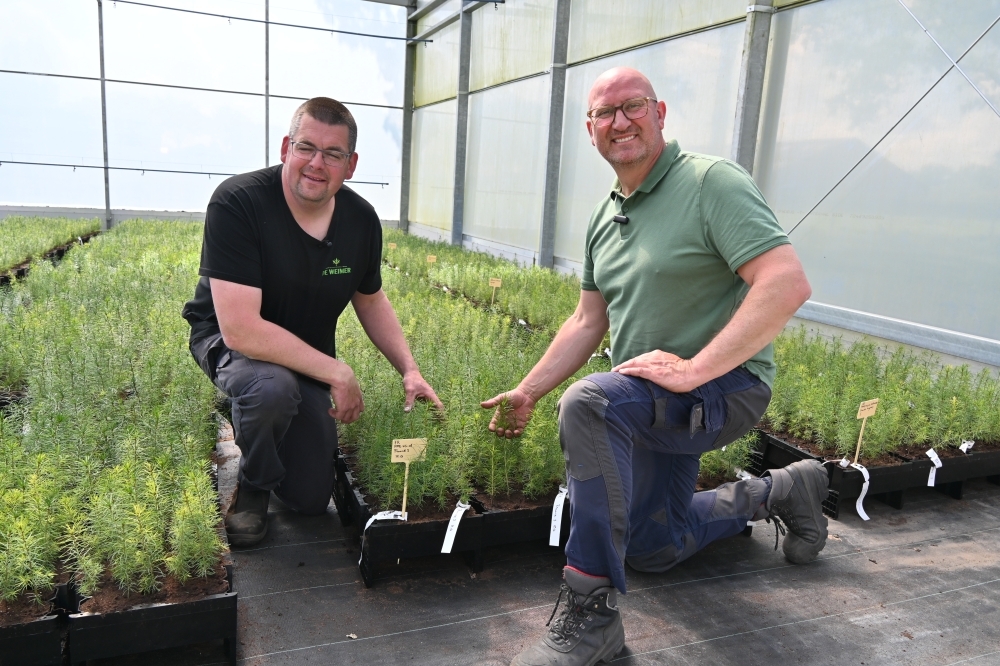
The cultivation of young plants is slowly shifting from field plots to container fields. While open field cultivation was the standard for many years, increasingly more tree nurseries are experimenting with plugs, trays and container cultivation. Not because open field cultivation is suddenly disappearing, but because the demands for uniformity, delivery reliability and mechanical processing are increasing rapidly. Boomkwekerij De Weimer in Zundert is one of the companies right in the middle of this development.
Within the tree nursery industry, the pressure to produce more consistently and predictably is increasing. Labour is becoming more expensive, water management more complex and customers increasingly demand uniform batches that can be processed directly.
This is becoming especially important for young plants. Differences in growth, rooting or uniformity later directly affect sorting, potting and delivery quality further down the chain.
At the same time, technology is also changing at many nurseries. Mechanisation and automation require starting material that reacts predictably.
“Young plants are becoming increasingly more important,” says Corné Lenaerts of Boomkwekerij De Weimer in Zundert. “In the past, you could still correct a lot during the next cultivation phase. Now the foundation already has to be much more consistent.”
Open field cultivation remains important
Still, this development does not mean that growers are massively abandoning open field cultivation. For many crops, open field cultivation remains economically attractive and technically reliable.
At De Weimer, open field and container cultivation still exist side by side for now as well. On one plot, young plants grow traditionally in open soil, while a few dozen metres further, trays and plugs are neatly arranged on container fields.
According to Lenaerts, the biggest change mainly lies in the way growers look at young plants.
“In open field cultivation, you remain dependent on the plot,” he says. “One section grows faster than another. Especially with young plants, you quickly see that reflected in uniformity.”
According to him, that does not necessarily have to be a problem, but the margins within the chain are becoming smaller.
“More and more processes are being mechanised. Then the starting material has to react the same everywhere.”
More control over roots and growth
To gain more control over uniformity and rooting, more and more companies are experimenting with plug and tray cultivation. According to Rob Tolenaars of TTS, the focus is increasingly shifting from above-ground growth to root quality.
“In the end, a compact plant with a strong root system is more valuable than a lot of above-ground mass,” he says. “The root determines how quickly a plant establishes itself and continues growing.”
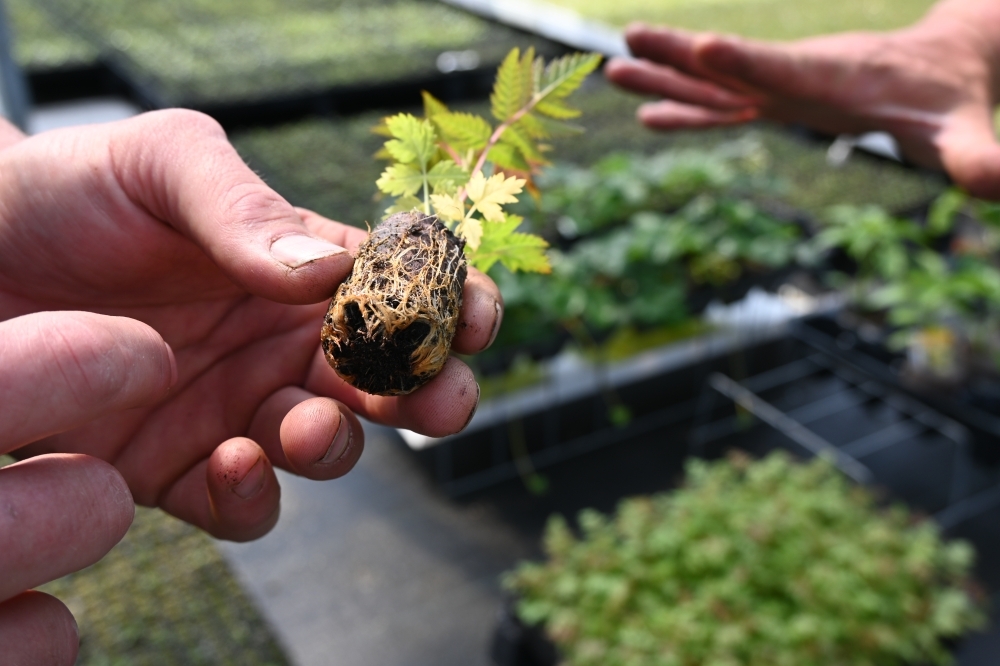
At De Weimer, a combination of agri-plugs and Air Trays is used. The plug forms the compact base in which the young plant develops, while the Air Tray provides air guidance around the roots.
Through this so-called air pruning, roots automatically stop growing when they come into contact with air. This creates a compact and strongly branched root system without circling roots.
According to Tolenaars, plug and tray strengthen each other precisely during that first growth phase.
“The plug provides uniformity and stability during cultivation, while the Air Tray actively guides the root system,” he explains. “That results in a young plant that continues to grow more evenly.”
According to Marc Lodders of NL Plants, this fits the broader development he sees within the industry.
“More and more links in the chain want predictability,” says Lodders. “That starts with the young plant. If that is uniform, the entire next cultivation phase benefits from it.”
For De Weimer, that is exactly where the added value lies.
“It increases uniformity,” says Lenaerts. “From the first to the last plant, you get a more consistent root structure. That makes the next cultivation phase more predictable.”
Container cultivation requires more precision
Still, according to growers, container cultivation also has clear challenges. Whereas open field cultivation still provides some buffer, plants in trays react much faster to mistakes in irrigation or nutrition.
“With young plants, everything revolves around consistency,” says Lenaerts. “Too wet, too dry or growth stagnation immediately becomes visible in uniformity. That means you have to manage much more precisely than before.”
He feels that water management in particular is becoming increasingly important.
“In trays, a plant reacts much faster. In open field cultivation, you still have some buffer in the soil, but in container cultivation you have to stay much closer to it. One hot day can immediately make a difference in growth or rooting.”
According to him, container cultivation therefore also requires a different way of working.
“Sometimes, people underestimate that. Placing a tray does not automatically make things easier. The entire system has to be right: irrigation, substrate, nutrition and climate. Everything interacts.”
Investments also play a role. Container fields, water technology, trays and automation require substantial adjustments within the business. That is precisely why many growers currently opt for a hybrid model in which open field and container cultivation continue to exist side by side.
Developing step by step
De Weimer also deliberately chooses this gradual approach. The nursery wants to gain experience without immediately becoming fully dependent on one system.
“We do not believe in just black and white,” says Lenaerts. “It is not either open field or container cultivation. For each crop, you look at what works best.”
According to him, container cultivation in young plants will continue to grow in the coming years. Mainly because the demand for uniform and directly processable plants continues to increase.
“The chain is becoming more professional. Then, as a grower, you also have to continue developing.”
At the same time, he does not expect traditional tree nursery knowledge to become less important.
“You still need to know how to grow plants,” he says. “You just add more technology and more control to it.”
For De Weimer, the development is mainly about future-proofing.
“We are not suddenly changing everything overnight,” Lenaerts concludes. “But you do need to keep developing. Standing still is no longer an option in this sector.”
Author: Jan van Staalduinen