Fourth Generation Have Taken Over Solgården
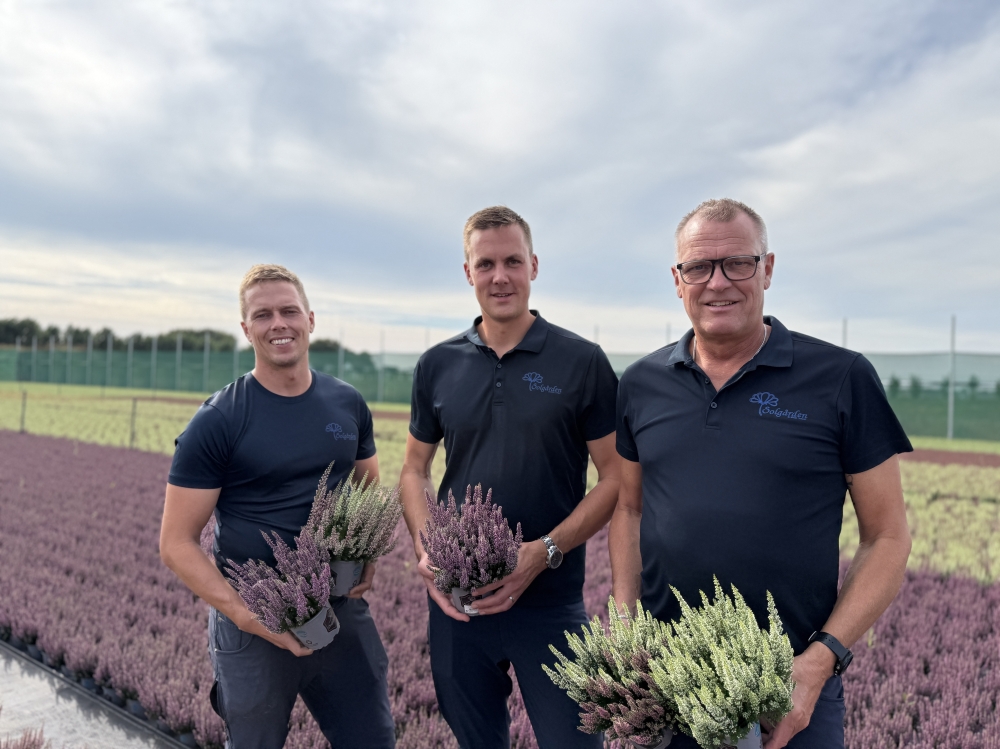
At the ornamental plant company Solgården in southern Sweden, a generational transition was officially completed in January. The new owners have been active within the company for many years and will continue to build on the strong brand that Solgården has become since its founding in 1958.
Two generations of the Wallin family meet among flowering fields at Solgården. Håkan Wallin took over the company from his parents in 2006, and earlier this year ownership was passed on to his son Jens Wallin and son-in-law Alexander Wallin.
Both Jens and Alexander have been involved in Solgården for many years, and the leadership transition had been underway for approximately five years before the ownership transfer was officially completed in January.
A generational shift of this kind within the industry is not always as self-evident today as it once was, but Jens and Alexander have a clear vision for how they want to run Solgården.
"Solgården is a strong name in the industry, and we want to carry that forward by continuing to create products of high quality. We also want to keep raising our minimum standard and become even better", says Jens.
Turnover Doubled
The company was founded in 1958, when Håkan’s grandmother and grandfather established the nursery. His parents took over ownership in 1985, and when Håkan and his wife Jeanette took charge, they immediately set a goal of doubling turnover.
Solgården employs 15 full-time staff throughout the year, and during the season from February to September up to ten additional employees join the company.
"I am now trying life as an employee. It is a great joy for me to have Jens and Alex on board", says Håkan.
Within the management team, Jens and Alexander have different roles, with Jens focusing on the sales company while Alexander is responsible for the production company.
Growing Year-Round
Running a successful company like Solgården requires deep knowledge of environmental and sustainability issues, economics, and, of course, how to grow high-quality products.
"We want our plants to remain attractive for a long time for the consumer. I believe that the fact that we grow in Sweden and that most of our customers are located within the country is an advantage, since the plant material is already adapted to our climate", says Alexander.
Jens explains that there is strong consumer interest in Swedish-grown products.
"The Från Sverige (From Sweden) label is a great initiative that has helped many consumers become aware of the certification across numerous product categories, not least ornamental plants."
Although most of Solgården’s products remain in Sweden, certain products are also exported abroad, for example to Germany.
"We grow something throughout the entire year, from Viola to Calluna and Amaryllis", says Alexander.
Investments in Technology
Over the years—primarily from 2016 until today—the company has made major investments in developing its facilities to improve ergonomics for employees and increase energy efficiency. Among other things, three kilometers of conveyor belts run through the premises.
"This investment has meant that our employees are actually a little happier and have more energy when they leave work at the end of the day", says Håkan.
Most of the greenhouses are made of aluminum, with one or two constructed from wood. Going forward, they will be equipped with new screens to save additional energy during cold days and to keep temperatures lower during the summer months. All water used in the nursery is collected and reused in a closed system. Rainwater from the roofs is also collected and used.
Quality standards
Solgården was the first company in Sweden to grow Calluna on a commercial scale, and this product category remains an important part of the business.
The company sells its products to wholesalers, grocery retailers, and garden centers. Although the assortment remains relatively stable over time, certain adjustments are made to varieties and color ranges in order to match consumer demand. Inspiration is found at trade fairs and among young plant suppliers.
"Developing new products is relatively time-consuming because we want to carry out trial cultivation to ensure that the plants meet the quality standards we expect", says Alexander.
Text: Cecilia Karlsson