Why do we do things this way?
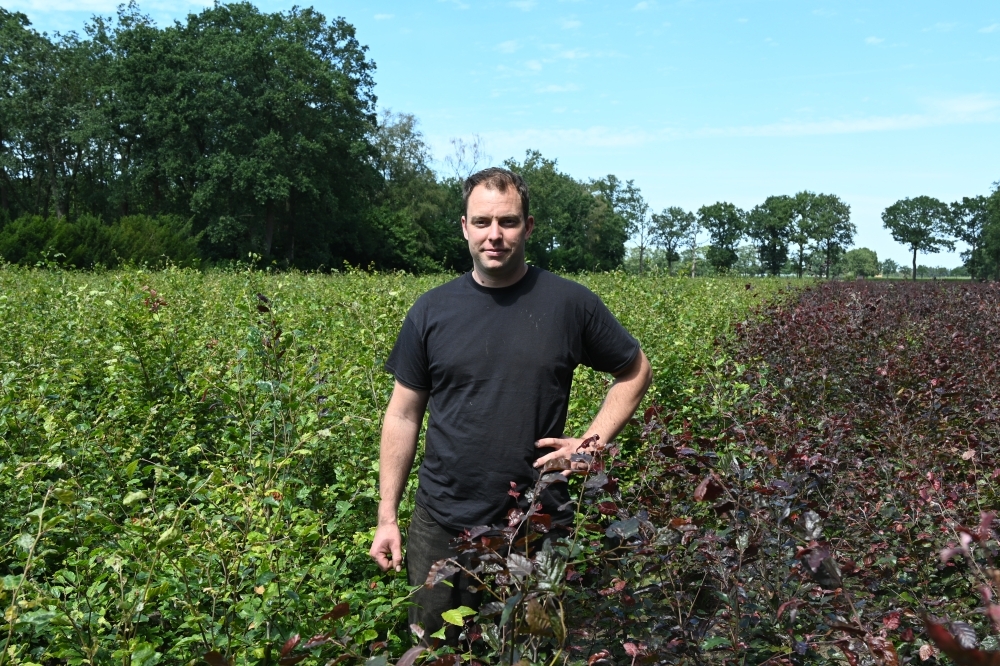
A good grower and a good entrepreneur are rarely the same person. One finds satisfaction in producing the perfect crop, while the other focuses on building a future-proof business. At Hergo Nursery in Zundert, these two worlds seem to come together remarkably well.
Even before the conversation turns to trees, sales or staffing, Styen Herijgers points to an irrigation reel. In his opinion, the drive system could be improved. It may seem like a minor detail, but it says a great deal about the way he runs his business. At Hergo Boomkwekerij in Zundert, improvement rarely starts with a major strategic plan. It almost always begins with one simple question: why do we actually do it this way?
“A good grower and a good entrepreneur are usually two different people.”
It is almost a fleeting comment. Many growers are excellent craftsmen, but entrepreneurship requires something more: looking ahead, investing and daring to move away from established practices. That last point characterises him. Not because he wants to innovate at any cost, but because he finds it difficult to accept processes that exist simply because they have always been done that way.
His biggest frustration?
The remark “We've always done it this way.”
To him, that is not an explanation but the start of a discussion. If a machine can be improved, it is modified. If contract work causes root damage, the working method needs to change. Not because investing is an objective in itself, but because otherwise the same mistake will simply be repeated next year. Problems are not solved by accepting them, but by eliminating their cause.
This mindset has shaped Hergo. Not through one major innovation, but through dozens of small improvements. Many operations are deliberately carried out in-house, because you can only improve what you truly understand. Machines are modified, processes refined, and investments are only made when they demonstrably contribute to a better result. No revolution, but continuous evolution.
The same way of thinking can be seen in Hergo's market approach. Herijgers does not believe in chasing yesterday's success stories. Every year he sees the same pattern: one crop performs well, prices increase, and shortly afterwards much of the industry decides to grow exactly the same crop. By the time those plants are ready for sale, supply exceeds demand and profitability disappears.
According to him, the copper beech is a perfect example. One good season can make a crop attractive, but that is precisely when caution is needed. Entrepreneurship is not about producing what was successful yesterday, but about anticipating what the market will need several years from now. Those who only respond to today's prices, will ultimately find themselves behind.
Based on that same belief, Hergo has also invested in Poland. Not because it is currently the largest market, but because Herijgers believes you need to establish a presence before a market truly develops. Relationships should be built before growth begins, not afterwards. The fact that the war has slowed that development down does not change his belief.
His interest in mechanisation is not driven by a fascination with technology either. Autonomous tractors, laser technology and other innovations are not goals in themselves, but logical answers to challenges that every grower sees approaching: labour shortages, stricter regulations and the need to work more efficiently. The focus is not on the machine, but on the problem it solves.
Even his greatest frustrations from the past season tell the same story. Mice and pigeons cause damage, but Herijgers does not dwell on the nuisance itself. Protective covers keep pigeons away, but at the same time provide shelter for mice. According to him, a solution that creates a new problem is not a real solution. So the search starts again. Perhaps the answer lies in new technology, or perhaps in traditional practical knowledge that has gradually faded into the background.
Anyone who talks to Herijgers quickly notices that he does not see himself as an innovator. He prefers talking about daily work, crops, machines and decisions that may seem small at first. Yet that is exactly where his entrepreneurship lies. Not in one major breakthrough, but in the accumulation of dozens of improvements that together make the difference.
Perhaps that is also why the line between grower and entrepreneur is so difficult to draw at Hergo. A passion for the crop remains the foundation, but equally important is the curiosity to discover how tomorrow can be better than today. Not because it has to be, but because one question continues to occupy his mind:
Why do we actually do it this way?