‘The eye of the master cannot be mechanised’
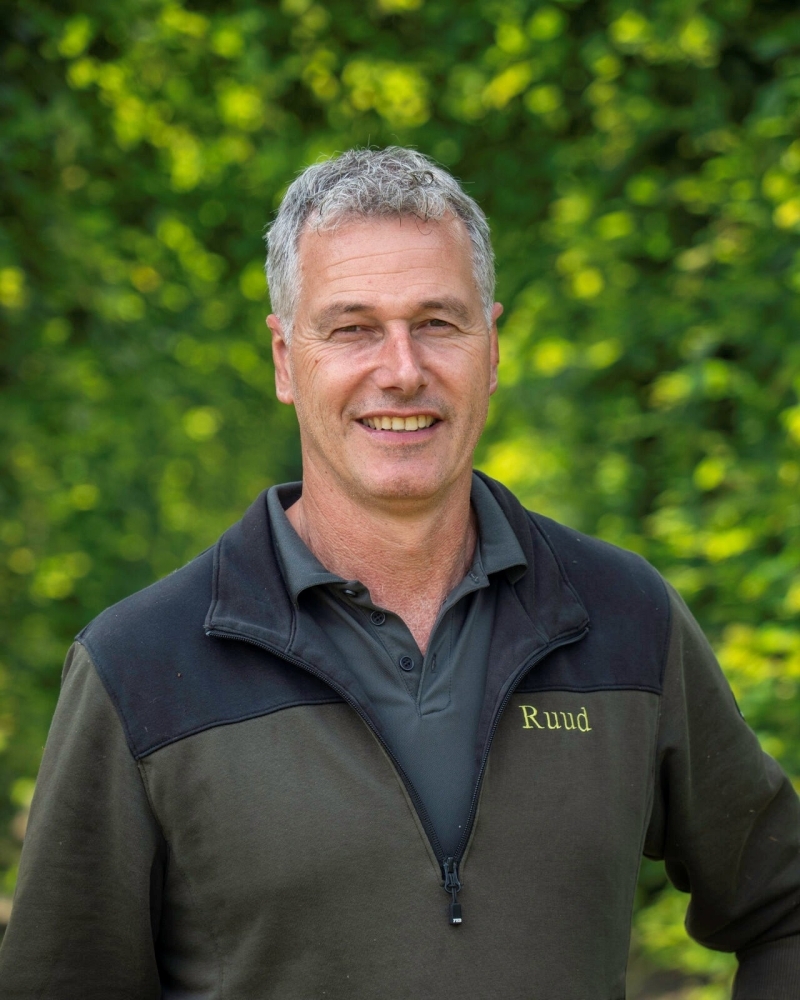
Mechanise whatever you can. It has almost become a rule in tree production. At Van den Berk, however, there is a clear limit to how far mechanisation can go. A roof-trained tree, screen tree or standard with a block-shaped crown does not become perfect by itself. People spend years pruning, training and shaping these trees. With some crops taking up to six years to produce, Ruud van den Berk also has to decide today which trees the market will want tomorrow.
So when is a trained tree actually finished? Van den Berk does not have to think long about the answer.
‘For us, a good trained tree is one that has completely filled out. A roof-trained tree, screen tree or block form has to be one hundred percent full.’
Different criteria apply to multi-stem trees. They need to be well branched, properly pruned and ultimately look right as a complete tree.
This is where mechanisation stops
Many operations around the tree can now be mechanised. Field work, lifting and moving trees: wherever machines can help, they are used. But when it comes to actually shaping the tree, Van den Berk says mechanisation quickly reaches its limits.
‘Shaping these trees is still entirely done by hand.’
A trained tree has to be carefully guided into shape. With multi-stem trees, crossing and rubbing branches need to be removed, branching must be right from the base and the crown ultimately has to be well balanced.
‘You can’t just do whatever you like.’
Labour is therefore an important element in the business. Not only because of the number of hours involved, but especially because the work cannot be done by just anyone. New employees, trainees and students work alongside experienced staff and learn the craft in practice.
‘We need skilled people.’
Is it painstaking work? Van den Berk laughs. ‘No, it’s great work. But you do need to know what you’re doing.’
Perhaps one day a robot will be able to do it. ‘But I actually hope it doesn’t come to that. I don’t think the result would be better.’
Choosing today for six years from now
Some crops at Van den Berk take six years to produce. What is planted today therefore has to suit a market that is still years away.
That makes looking ahead essential, particularly as climate, diseases and pests increasingly influence the assortment. Some trees are struggling more with periods of extreme rainfall, heat or drought, while species that were rarely used in the past are becoming more interesting.
At the same time, the use of chemical crop protection is becoming more restricted, and Van den Berk wants to minimise his dependence on it.
‘We simply need healthy, strong trees that can cope with the climate and are as resistant to diseases as possible.’
Discovering an interesting new species or cultivar, however, does not mean he immediately starts producing it in large numbers.
‘If the customer doesn’t know it, they won’t buy it.’
So Van den Berk starts small. A new tree first needs to be seen and tried before production is scaled up.
‘It’s a process that takes years. It’s not a case of: nice tree, let’s produce a hundred of them.’
With such long production cycles, a wrong decision can still be standing in the field years later.
No revolution in the assortment
Van den Berk does not expect the assortment to change overnight. ‘You have to move with the market a little. It’s not as if one thing suddenly disappears and another takes its place.’
Even trees that are becoming more vulnerable to extreme weather conditions remain in demand. Particularly in larger projects, growing sites, drainage and irrigation are often properly planned. Existing assortments therefore retain their place, while opportunities are also emerging for stronger and healthier alternatives.
One example is Tilia mongolica ‘Buda’, which Van den Berk has seen gaining ground as a screen tree in recent years.
‘It’s an aphid-free lime, and it has beautiful foliage.’
Van den Berk mainly supplies larger trading companies and nurseries throughout Europe, which in turn supply landscapers and landscape contractors. Specific trained trees in particular tend to be purchased on a project basis. If a project requires ten pleached trees, the customer buys ten – not another five just to keep in stock.
Looking ahead is therefore at least as important as growing well.
Opportunities for Dutch production
Despite the long production cycles and dependence on skilled labour, Van den Berk is positive about the future of Dutch tree production. What he sees during his travels through Europe only reinforces that confidence.
Traditional German companies have often combined everything under one roof for years: retail sales, trade and their own production, ranging from small shrubs to large trees. According to Van den Berk, that model is coming under pressure.
‘At many of those nurseries, production is disappearing. The younger generation says: we’d be better off stopping that part of the business.’
But demand for trees does not disappear with it. Van den Berk therefore sees opportunities for specialised Dutch production nurseries.
Labour is expensive in the Netherlands and skilled workers are difficult to find, but according to Van den Berk the same problem now exists throughout Europe. Specialisation and quality can therefore continue to make the difference.
Ultimately, his approach comes down to something very simple: delivering a tree that is right in every respect.
‘Our product simply has to be superb. Top quality, perfect. If we can do that, we’ll find a customer for it.’