- HOME >
- NEWS >
- Cultivation 05-10-2026
Treeport looks ahead to the tree nursery industry in 2045 with young entrepreneurs
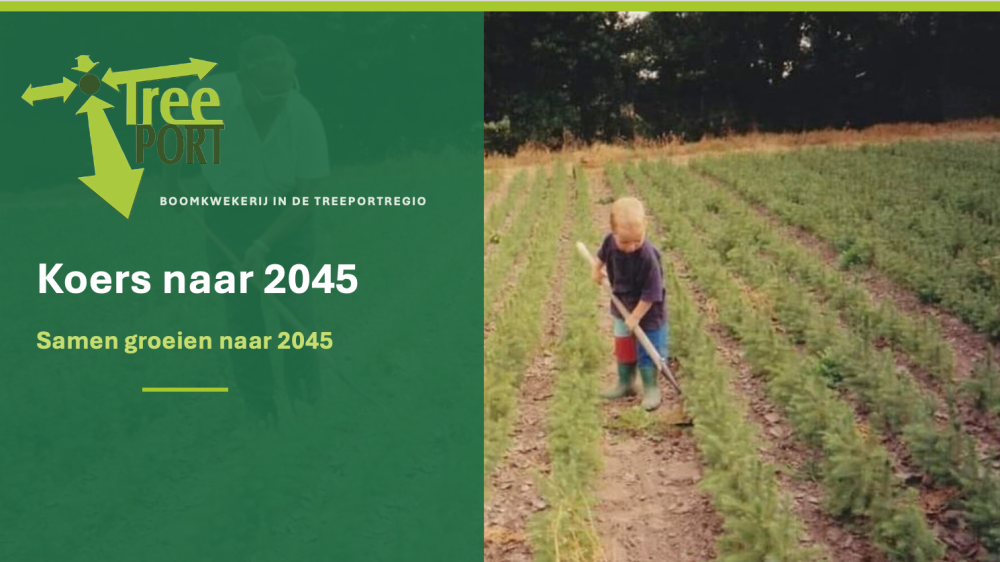
What will the tree nursery industry in the Treeport region look like in 2045, and what is needed to get there? That question took centre stage at GrootGroenPlus on Friday morning. Rowy Roelands of Roelands Boomkwekerijen BV and Krijn Overbeke, who works at Huijbregts Boomkwekerij BV, guided all attendees through the course Treeport has set for the next twenty years.
Roelands is one of the young people who contributed to the vision, which was also presented to Angelien Hagenaars of Waterschap Brabantse Delta. The fact that the vision was presented by young entrepreneurs – both members of the Treeport Members’ Council – fits with one of its key principles: the future of the tree nursery industry should be shaped not only for, but also with the next generation.
Long-term cultivation requires long-term clarity
The central ambition is clear. Treeport wants the tree nursery industry to remain economically strong in 2045 while at the same time making an indispensable contribution to the climate, biodiversity and quality of life. According to the organisation, this requires clear agreements now about the conditions under which entrepreneurs can continue to produce in the future.
This long-term perspective is particularly important for the tree nursery industry. Trees and plants are often cultivated for many years, while entrepreneurs face changes relating to climate, water, regulations, energy, the labour market and plant health. At the same time, demand is growing for climate-resilient trees and plants, biodiversity and healthy living environments.
The message during the presentation was that the question is not so much whether the tree nursery industry has a future, but under what conditions that future can be realised.
Three central themes
During the presentation, Roelands and Overbeke summarised the vision in three central themes: certainty for entrepreneurs, healthy plants and innovation, and the next generation.
Water, soil, energy and space play an important role in the first theme. Among other things, Treeport wants to make agreements with public authorities and water boards on water availability, water quality, soil, fertilisation and crop protection. Entrepreneurs need long-term clarity in order to make targeted investments.
Plant health and innovation also received considerable attention. Prevention, monitoring and rapid diagnostics are becoming increasingly important. At the same time, robotisation, sensors, data and AI offer opportunities to work more intelligently and precisely. ROOTZ should continue to develop as a place where entrepreneurs, educational institutions, researchers and technology companies bring knowledge and innovations together in practice.
Not only for, but with young people
The third theme is particularly close to the presenters themselves: the next generation. Although Roelands and Overbeke currently belong to the younger generation within the tree nursery industry, the vision states that it is already necessary to think about the entrepreneurs and employees who will follow them.
Treeport therefore wants to build an ongoing relationship with young people, from their first introduction to the tree nursery industry at primary school through secondary vocational and higher professional education, internships and practical learning, and ultimately to working or running a business in the tree nursery industry.
Business succession, good employment practices and a structural voice for young people within the organisation are also part of this.
From vision to implementation
The course towards 2045 is explicitly not intended to become a document that simply sits on a shelf. The vision must be translated into programmes, annual plans, agreements, concrete objectives and pilot projects.
The first period, from 2026 to 2030, will focus, among other things, on strengthening the organisation, carrying out baseline measurements and preparing agreements on water, plant health, knowledge sharing, internships and services. In the years that follow, successful pilot projects are to be scaled up and programmes relating to innovation, entrepreneurship and education are to become more structural.
Ultimately, the ambition is for the Treeport region to be an economically strong, innovative and socially valued cluster for trees and plants by 2045. A region that supplies not only trees and plants, but also knowledge and solutions for a climate-resilient living environment.
The essence of this was summarised during the presentation in a call for collaboration: jointly setting goals and making clear agreements with, among others, public authorities and water boards. Because those who cultivate for the long term also need to be able to do business for the long term.