Growers more positive about making the industry more sustainable despite concerns about the future
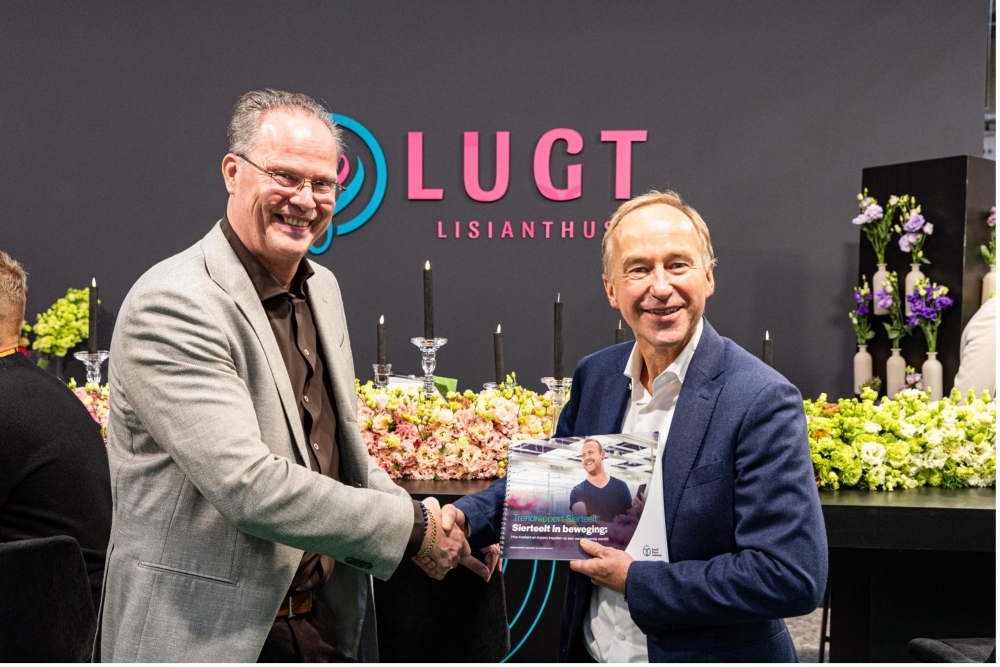
Growers in the floriculture sector have a more negative outlook on the sector’s future, according to Royal FloraHolland’s new Floriculture Trend Report. Whilst 70 per cent of growers were optimistic about the future last year, that figure has now fallen to just 54 per cent. Nevertheless, a positive trend is also evident: despite the current uncertainties, positive sentiment regarding sustainability is growing amongst growers. They consider ‘green’ crop protection, heat management, energy consumption and sustainable alternatives for transport to be particularly important in making the sector more sustainable.
Trend: more positive about industry sustainability
The Trend Report shows that floriculture growers’ attitudes towards making the industry more sustainable have become significantly more positive over the course of a year. Whereas last year only 49 per cent held a positive view on this, the figure now stands at 62 per cent. 88 per cent of growers state that they have implemented changes to grow more sustainably. Pieter Bootsma, CEO of Royal FloraHolland: “Growers’ concerns about the future are a signal we must take seriously. The Netherlands is a world-class flower-growing nation, but that will not remain the case automatically. Our growers have the ambition and innovative capacity to drive the industry forward, partly thanks to their positive attitude towards sustainability. Now we must work together to ensure they are given the scope to do so.”
Marcel van der Lugt, co-owner of Lugt Lisianthus and chair of the RFH Members’ Council, emphasises the value of the Trend Report: “Growers want to move forward, but we must be given the scope to do so. The Trend Report highlights where we see opportunities and where we face challenges. For us as the Members’ Council, these are important signals to take into account in the discussion about the future of our cooperative and the industry.”
It is striking that buyers are increasingly willing to pay more for a sustainable range. This need not lead to lower profits, as the figures from the Trend Report show. There has been a decline in the willingness to accept lower profits if this enables greater sustainability (from 25 per cent to 15 per cent).
Two-thirds fully self-sufficient
Many operating conditions are currently changing for floriculture growers, including requirements relating to water. Growers are increasingly having to anticipate changing legislation, new water quality requirements, longer periods without rain and other consequences of climate change. The Trend Report shows that growers do not want to be dependent on these factors: two-thirds (66 per cent) therefore describe themselves as fully self-sufficient in terms of water, collecting enough water for their own cultivation. Sustainable water management is widely practised: three-quarters collect rainwater and half reuse drainage or recirculated water. A third still rely on surface water for their water supply.
Water quality is also becoming an increasingly important priority for growers. More than half (51 per cent) monitor their own water quality. Water quality will move higher up the list of priorities for many growers with the forthcoming European Water Framework Directive coming into force in 2027. Bootsma adds: “The targets set out in the Framework Directive present a significant challenge for the industry, particularly regarding water quality. Many growers are already working on this, but half will still need to take further steps in areas such as water monitoring. Royal FloraHolland supports growers in this by sharing knowledge and providing practical information. The water coaches from Glastuinbouw Nederland can also help growers take concrete action. In this way, we are working together as a industry to build a future-proof industry.”
Use of AI in the industry
More and more business owners are beginning to explore how AI can help optimise their business operations, for example in terms of water and energy consumption or for predicting diseases or pests. It also offers possibilities for supporting production and cultivation decisions or organising trade more efficiently. Currently, 23 per cent of growers state that they use AI for financial administration and forecasting. Together, we are exploring how we can widely share these new developments and insights within the industry.