- HOME >
- NEWS >
- Cultivation 17-03-2026
Compact Hydrangea conquers the market
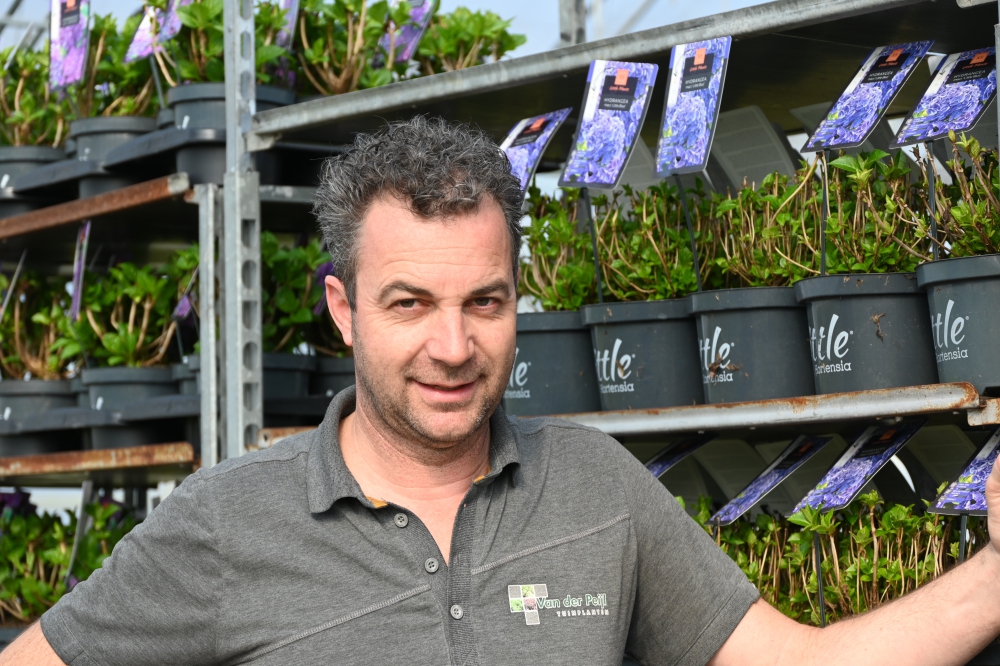
In a market where hydrangeas are widely available in large volumes, it may seem difficult to introduce a truly distinctive variety. Yet that is exactly what Jean-Pierre van der Peijl of Van der Peijl Tuinplanten has achieved. With his so-called Little Hydrangea concept, he developed a series of compact hydrangeas that naturally remain low-growing, aligning better with consumer expectations. What started as a simple observation in a garden centre has grown into a proprietary line with international protection and distribution far beyond Europe.
Hydrangeas that stay compact
The core of the concept is straightforward: hydrangeas that grow no taller than about sixty centimetres. This may sound like a small adjustment, but in practice it addresses a very common issue in consumer gardens.
“Many people love hydrangeas, but they become frustrated because the plants eventually grow much larger than expected,” Van der Peijl explains. “Then they have to start pruning, while they are often unsure how to do it properly. With these hydrangeas, that problem simply doesn’t exist.”
The plants remain naturally compact and maintain their shape without intensive pruning. As a result, they are particularly suitable for smaller gardens, borders and terraces. In addition, they flower reliably, which makes maintenance straightforward for consumers.
“In fact, consumers hardly need to do anything. They stay compact and they always bloom.”
Five colours within one concept
The series now consists of five colours: white, red, blue, pink and purple. This allows retailers and traders to create variety within one recognisable concept.
Even smaller plants already show a good flower set. “Even the smallest plants often have around five buds,” Van der Peijl explains. “That immediately creates an attractive presentation at the point of sale.”
As with any hydrangea, early spring requires some attention. “When the plants start to grow, you have to be careful with frost, but that applies to virtually all hydrangeas.”
Originating from a simple insight
The idea behind the series emerged more than thirteen years ago in a surprisingly simple way. In a garden centre, Van der Peijl noticed a hydrangea labelled as a “dwarf variety”.
“That plant sold three times as much as the others,” he recalls. “At that moment I realised there was clearly demand for this. So I thought: we should do something with that.”
That insight became the starting point for a selection process that eventually resulted in four suitable varieties. The process, however, proved far from simple.
“Breeding is largely a matter of discarding,” Van der Peijl says. “We started with eleven varieties and eventually had to reject seven. They grew too tall, were not strong enough or simply did not meet our standards.”
Selection and collaboration
For the breeding work, Van der Peijl collaborated with specialised partners. His own focus lies mainly on selection, cultivation and market development.
“Breeding has become so specialised that you either do it properly or not at all,” he says. “I prefer to leave that part to people who are fully specialised in it. Our strength lies in growing the plants and bringing them to market.”
That strategy fits the position of the company, which already has an extensive distribution network.
Protection and international market
The varieties are legally protected, which means other growers cannot simply propagate them. This protection applies both within Europe and internationally.
The plants are even being grown in Japan. “They produce around ten to twenty thousand plants per year there,” Van der Peijl explains. “I will travel there this summer to see how everything is developing.”
This international interest demonstrates that compact hydrangeas represent an attractive niche worldwide.
Own production and distribution
Remarkably, Van der Peijl keeps production and distribution largely in his own hands. In Europe, the plants are currently grown exclusively by his own company.
This approach allows strict control over quality and market positioning. At the same time, the plants are sold through various channels, ranging from retail to the wholesale trade.
“We basically supply anyone who approaches us,” he says. “Most sales channels are represented in our network.”
Today, the production volume amounts to around 140,000 plants per season, divided across the five colours.
Private label with recognisable origin
The plants can also be supplied under private label, but a recognisable element of the original concept always remains.
“There is always a printed pot underneath,” Van der Peijl explains. “That way we can ensure that no one markets something under our brand name without control.”
For landscape applications, labels are often less relevant, which makes the printed pot a practical way to maintain recognisability.
Down-to-earth success
Despite the success, Van der Peijl remains modest about the achievement.
“I have also tried plenty of things that simply didn’t work,” he says. “But this one was a hit. And it’s nice to see how such a plant gradually grows in the market.”
According to him, the success of Little Hydrangea shows that even in a saturated market there is still room for innovation—provided a plant genuinely solves a problem for the consumer.