- HOME >
- NEWS >
- Technology 23-03-2026
Smarter irrigation: what growers learn from field trials in Zundert
One summer, growers face excess water, the next they deal with drought. Therefore, for tree nurseries in the Zundert growing area, water management is becoming increasingly important. Within the Irrigation Techniques project, entrepreneurs, advisors and the water board are investigating how water can be used more efficiently in open field cultivation. Field trials at companies, including Hergo Boomkwekerij, show that better measurements and smarter techniques can quickly lead to water savings, without compromising cultivation.
Field trials at Hergo
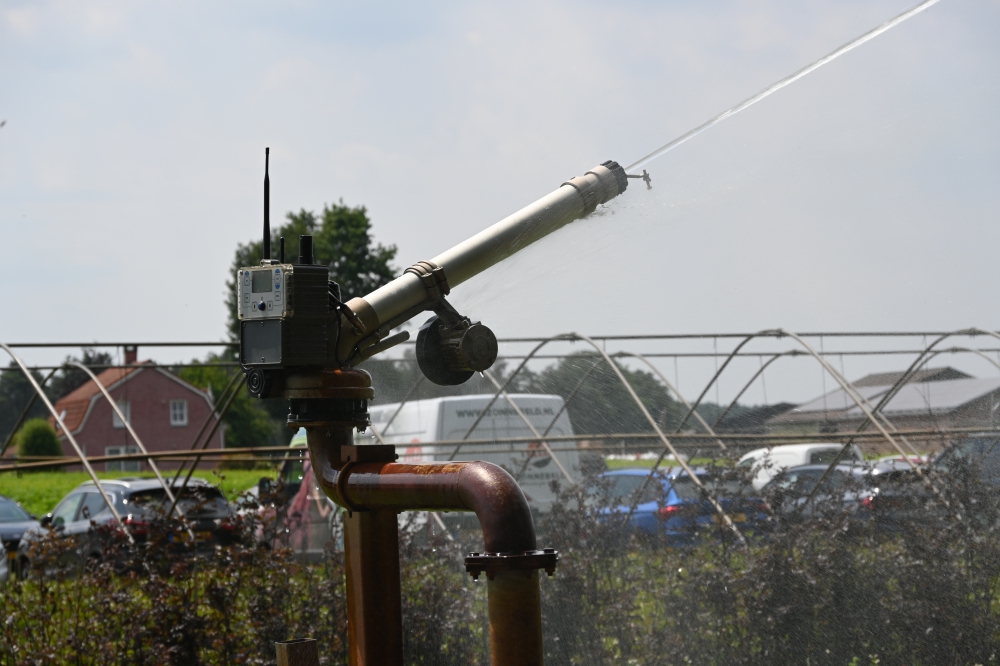
One of the companies where new techniques are being tested is Hergo Boomkwekerij in Zundert. Entrepreneur Styen Herijgers is working there on trials with different irrigation systems. On his plots, tests are being carried out with, among other things, an adapted hose reel that can irrigate more precisely. The installation is equipped with a smart head which stays within the plot boundaries and prevents water from ending up on areas where no crops are grown.
The field trials are part of a wider collaboration between growers, advisors and policymakers. The aim is to gain insight into the efficiency of different techniques and to examine how water use can be reduced in practice.
The Irrigation Techniques project originated from a collaboration between, among others, the Brabantse Delta Water Board, Coöperatieve Vereniging Treeport Zundert, ZLTO and several growers from the region. It is part of the regional program Water in Balans (water in balance), in which authorities and entrepreneurs work together towards a future-proof water system in the Zundert cultivation area.
Within the project, different irrigation methods are compared, including traditional hose reel irrigation, drip irrigation and irrigation controlled based on measurements. The trials are carried out at tree nurseries in the region. The results are intended to help entrepreneurs use water more consciously and to be better prepared for future restrictions on water use.
René Rijken, area advisor at Brabantse Delta Water Board: “After the drought of 2018, for the first time ever, growers here were no longer able to irrigate. That was the moment it became clear that water will not remain endlessly available.”
It was an important turning point. Until then, water was often seen as a self-evident production factor. In recent years, it has become clear that this is not always the case.
Finding the optimum
While the water board looks at the water system as a whole, Tijmen Dekkers of Deltae Innovation mainly focuses on what happens in the field. Within the project, various plots are monitored, measuring, among other things, soil moisture, water applications and crop growth.
“Too dry and too wet are both suboptimal. We have to find the most optimum, which might differ per lot.”
During the trials, it became clear that the moisture conditions within a plot often vary significantly. Nevertheless, in practice, the same amount of water is still often applied everywhere.
Dekkers: “In some places, the crop grows faster and requires less water than in other places. If you understand these differences better, you can already irrigate much more precisely.”
Hose reel or drip irrigation?
The first results of the drip irrigation trial show a more consistent moisture condition in the soil. At the same time, it is becoming clear that existing irrigation techniques can also still be improved.
Rijken: “A smart head allows for more precise irrigation with a hose reel.”
The trial at Hergo shows that an adapted hose reel head can already make a significant difference. By irrigating more precisely within the plot boundaries, water will not end up on areas without crops.
Measuring as a basis
An important lesson we drew from the project is that efficient irrigation starts with insight into one’s own water usage. Many entrepreneurs have a general idea of how much water they use, but have little insight into what exactly happens at plot level.
That is why, within the broader Water in Balance program, digital water meters have been installed at 22 companies, spread across dozens of groundwater wells. This gives entrepreneurs better insight into their actual water usage.
“Many companies report their water usage once a year, but in practice are not thinking about it on a daily basis. By measuring, you suddenly gain a wealth of information about your own business,” says Rijken.
For Dekkers, this is the first step towards more efficient water use. “The first step is not to immediately buy a new technique. First, you need to understand how the water management around your crop works. Measurements help with this.”
Toolbox for the industry
According to those involved, the project is explicitly not an attempt to prescribe one specific technique. The main goal is to gather knowledge and make it available to the industry. “We do not want to take the entrepreneur’s seat. We want to show what is possible and what results it delivers.”
It is expected that water availability will become an increasingly important theme in the coming years. By already gaining experience with new techniques and measurements, growers can better prepare for the future.
As Dekkers concludes: “Those who learn now how their water management works will have an advantage later on.”