- HOME >
- NEWS >
- Technology 02-04-2026
Water Insight: from measuring to managing water at field level
Water has long ceased to be a given for tree nurseries. Dry summers, wet winters, dry summers with wet periods, wet summers with dry periods, and increasing pressure on groundwater mean that growers must increasingly think about what is happening on their fields. But managing water starts with insight, and in practice that insight is often still lacking.
The project Water Insight, part of the Water in Balans (water in balance) programme of Waterschap Brabantse Delta, aims to change that. Not with models or assumptions, but with measurements at the nursery itself. This collaboration with growers shows how much water is used, when and where.
According to René Rijken of Waterschap Brabantse Delta, everything starts with insight.
“You need to know what you are doing before you can start managing it.”
Many growers work by intuition, and that intuition is often surprisingly accurate. But without data, it remains difficult to truly optimise.
“It’s not just about collecting data, but about turning data into information.”
Within the project, measurements of water extraction from surface water and groundwater are taken at nursery level. These data are not only collected, but also discussed annually with the grower.
“It’s not that you just get a meter,” says Rijken. “The discussion about the data is what makes it valuable.”
Hydrologist Klaas-Jan Douben, also working at Waterschap Brabantse Delta, sees that the strength of the project lies in translating data into practical decisions.
“It’s not just about collecting data, but about turning data into information.” By combining measurements with soil type, crop, irrigation method and weather conditions, a much clearer picture emerges of what is actually happening on the field.
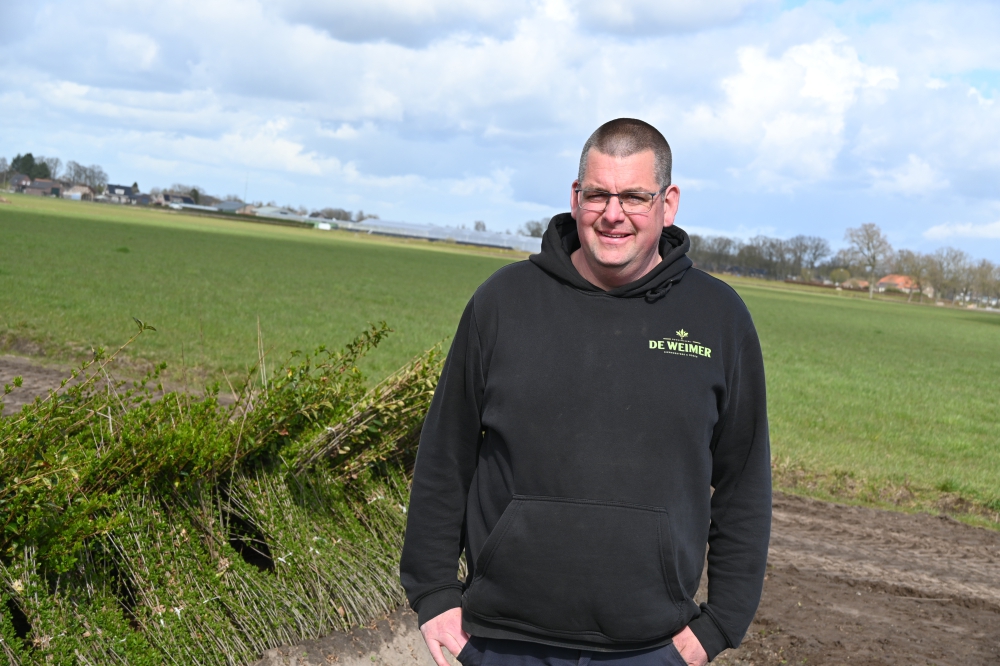
For Corné Leenaerts, who owns nursery De Weimer with his wife Cindy and is chairman of the ZLTO department Zundert-Rijsbergen, the value of the project lies mainly in the combination of intuition and data.
“You often work based on intuition, but it is valuable to be able to link intuition to measurements.”
At his nursery, the measurements initially confirmed what he was already doing.
“We are actually already on the right track,” he says. “We don’t irrigate in strong wind or during high daytime temperatures, but at night or under more favourable conditions.”
Still, the data provide nuance. “You gain insight into what you are doing, and that sometimes means you can wait just a bit longer before irrigating.”
An important insight from the project is that a field is rarely homogeneous. Yet in practice, irrigation is often still done in fixed rounds with fixed volumes. As Rijken summarises:
“The irrigation rounds and the capacity of the reel are often leading, not the data.”
With measurements and satellite data, differences become visible: wet spots, dry strips and variations in soil structure.
For Leenaerts, this mainly confirms what he already observed in practice. Growers usually know their soil well, but it is valuable to see that knowledge confirmed by data. This not only provides more certainty, but also creates opportunities to adjust irrigation more precisely.
According to Douben, evaporation also plays an important role. Not all water reaches the root zone, and part of it disappears without contributing to crop growth. This shifts the focus from quantity to effectiveness: it is not only about how much water you apply, but where it ends up and what the plant actually does with it.
For Leenaerts, the project goes beyond insight alone. The data also help with strategic decisions at company level.
“We also use the data to calculate whether we can move towards self-sufficient water use.”
When developing new container fields and water storage systems, he evaluates how far he can go in collecting and reusing water.
“On paper you can go a long way, but in practice there are always years in which you have to adjust.”
That is exactly where Water Insight shows its value. The project not only helps to understand current water use, but also helps to better support investments, permit applications and future decisions. Leenaerts sees it the same way and advises other growers to join the project.
“If policy is being made, it should be based on measurements from practice, not only from an office.”
“You need to know what you are doing before you can start managing it.”
With Water Insight, water is increasingly becoming a production factor that can be actively managed. The combination of practical experience and data makes it possible to grow more precisely, use water more efficiently and be better prepared for future requirements — not by using more water, but by using it more intelligently.